
What “Fish-Derived” Actually Means for a Reservoir Sitting on Your Kitchen Counter
A semi-hydro setup lives in your living room, not a greenhouse. When an input’s ingredient list includes fish hydrolysate, it’s a fair question whether that changes anything about having it around pets and kids.
Semi-hydro and LECA growers keep their reservoirs somewhere a tent grower never would — on a windowsill, a kitchen counter, a bookshelf next to where the cat naps. That changes what questions are worth asking about an input before it goes in the water. We’ve written before about why the chelate on a Cal-Mag label matters more in a small, unflushed reservoir, and about the four disclosure lines that appear on every Bloom label. This one is about a different kind of label-reading: what’s actually known about the safety of fish-derived biostimulants themselves, separate from the agronomic question of whether they work.
What the literature actually checked
A 2020 review of fish by-product biostimulants pulled together what’s been published on this specifically, and one citation stands out for a small-space grower: an independent assessment (Corte et al., 2014) evaluated fish-derived hydrolysate biostimulants and reported no genotoxicity, no ecotoxicity, and no phytotoxicity. In plain terms, the testing looked for three separate kinds of harm — damage to genetic material, toxicity to the surrounding environment, and toxicity to the plants themselves — and found none of the three in what was tested.
That’s a narrower and more honest claim than “fish inputs are safe,” full stop — it’s safety testing against three specific, named endpoints, in one assessment, of fish-derived hydrolysates generally. It isn’t a Bloom-specific trial, and we’re not presenting it as one. What it does establish is that the category has actually been looked at for these risks, rather than assumed safe because it’s “natural” or assumed risky because it smells like fish.
Reading the actual label, not the ingredient’s reputation
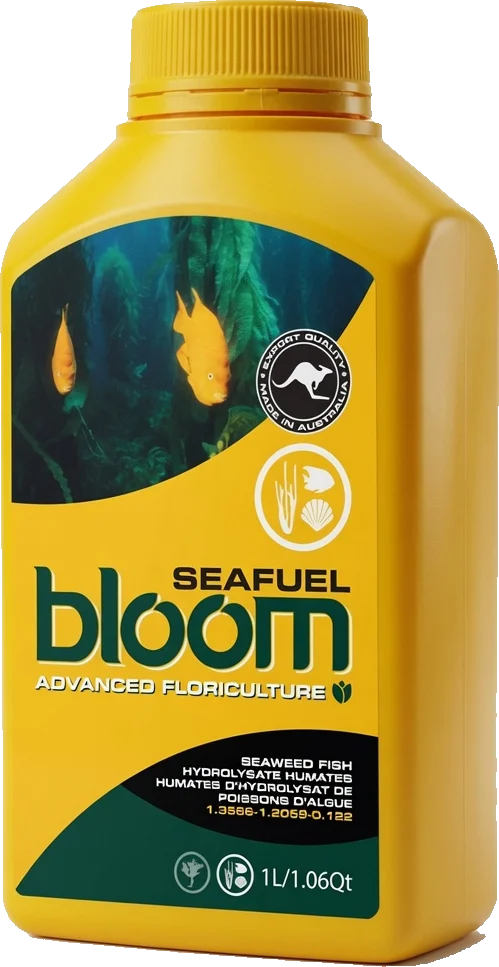
Bloom Seafuel declares Durvillaea potatorum seaplant extract and Hydrolized Blue Fin Tuna (Fish Hydrolysate) as its inputs, with 0.075% Humic Acid as a non-plant-food ingredient; its safety data sheet lists a pH of 4–5. None of that is a claim we’re making up to sound reassuring — it’s what’s printed on the artwork, which is the same standard we hold every Bloom sheet to, whether the subject is a label figure or a safety question. The honest caveat, same as always: a literature-level safety finding about fish hydrolysates as a category is not a substitute for reading your own product’s label and storing it the way any concentrated liquid fertilizer should be stored — out of reach of curious pets, away from food prep surfaces, same as you would with anything else in a kitchen cabinet.
That’s a smaller claim than “perfectly safe,” and it’s the one we can actually back up with a citation instead of a feeling. For a reservoir that lives in a living room rather than a grow tent, that distinction is worth having.
To put those three terms in plain context: a genotoxicity test checks whether a substance damages DNA or chromosomes in exposed cells — the kind of finding that would matter well beyond a plant’s root zone. An ecotoxicity test checks for harm to organisms in the surrounding environment, which for a liquid fertilizer usually means aquatic life and soil organisms if it runs off or is disposed of carelessly. A phytotoxicity test checks whether the product itself injures the plant it’s applied to, independent of whether it helps that plant grow. Testing negative on all three doesn’t mean a product has been cleared for every possible use or exposure scenario — it means that for the specific assessment cited, none of those three harms showed up.
That distinction matters for a semi-hydro grower weighing a fish-derived input against a synthetic alternative with a longer regulatory history. Neither comparison is really the point of this piece. The point is narrower: when an ingredient list includes something that sounds unfamiliar or slightly alarming next to a kitchen sink, it’s worth checking whether anyone has actually looked at the question, rather than guessing from the smell. In this case, someone has.
As with every post in this series, the standing caution applies: a literature finding about a category of input is not the same as a product-specific safety dossier, and good kitchen hygiene around any concentrated liquid product — fertilizer, cleaning solution, or otherwise — is just good practice, not a response to a specific risk we’re flagging here.
Sources: Madende M, Hayes M. Fish By-Product Use as Biostimulants: An Overview of the Current State of the Art, Including Relevant Legislation and Regulations within the EU and USA. Molecules 25(5):1122 (2020), citing Corte L, et al. (2014). Bloom Seafuel label artwork (verified derived-from and non-plant-food declarations).