
What Buying the Bigger Bottle Actually Saves You on a Propagation Bench
A cut-flower propagation bench doesn’t run on a once-a-week feed — the solution turns over constantly, and a small bottle means a reorder lands on your desk every few weeks whether you have time for it or not. The cost-per-use arithmetic on sizing up is simple enough to do once and stop thinking about.
The same dose, four bottle sizes
Seafuel‘s labeled rate is 1 ml/L of feed solution — about 3.785 ml per US gallon. At that rate, and at Bloom’s own listed retail pricing, the cost per treated gallon drops every time you size up: the 300 ml bottle works out to roughly 21¢ per gallon, the 1 L bottle to about 13¢, the 2.5 L to about 10¢, and the 15 L to about 9¢. Put another way: the 300 ml bottle treats about 79 gallons before it’s empty; the 1 L treats roughly 264 gallons; the 2.5 L about 660 gallons; and the 15 L jug covers nearly 4,000 gallons of feed solution at the labeled rate. The jump in coverage between sizes is much bigger than the jump in price — the 15 L costs about 20 times what the 300 ml does, but holds 50 times the volume. The dose doesn’t change — only how many gallons one bottle actually covers before you’re back at the shelf.
That math only pays off if the bigger bottle actually gets used before you’d otherwise reorder anyway. A single-tray propagation setup running through a few gallons a week doesn’t need a 15 L jug taking up shelf space for months — the per-gallon savings on paper doesn’t help if the bottle’s sitting half-used when the next grow cycle changes what you’re dosing. The arithmetic favors sizing up specifically when the bench’s actual turnover — gallons mixed per week, times weeks until the next planned reorder — comfortably clears what the bigger bottle holds. For a bench running continuously through a full propagation season, that’s usually the case; for an occasional home setup, the smaller bottle can still be the right call even at a higher per-gallon price.
There’s a simple way to check which side of that line a given bench falls on: estimate how many gallons of feed solution actually get mixed in a typical week, multiply by the number of weeks until the next time the program or product might change, and compare that total against the gallon coverage of each bottle size above. A bench mixing even five or six gallons a week during an active propagation run will clear the 1 L bottle’s roughly 264-gallon coverage well within a season, which is the point at which the 2.5 L or 15 L sizes start paying for themselves rather than just sitting on a shelf.
Cost per treated gallon by bottle size (at 1 ml/L)
Based on Bloom’s listed retail pricing and the 1 ml/L labeled dose rate, at time of writing. Prices can change — check the current listing before ordering a larger size.
Why this matters more heading into a busy run
None of this is about buying more than a bench actually needs — it’s about not running out mid-cycle, or re-ordering a small bottle every few weeks when one larger order would have covered the same stretch of propagation for less, with one fewer thing to remember. For a bench that’s feeding continuously rather than on a weekly top-up, that difference adds up fast.
Fall is a reasonable point to actually run this math, rather than defaulting to whatever size is already on the shelf: a propagation program heading into a new cycle is a natural moment to size the next order against the volume the bench is realistically going through, instead of restocking on autopilot.
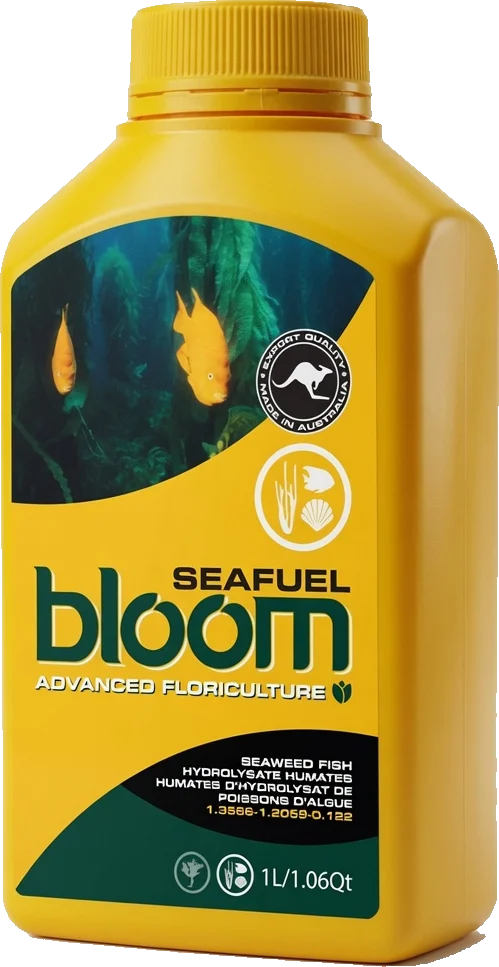
Bloom Seafuel — 1 ml/L, available from 300 ml up to 15 L.
The dose on the label doesn’t move. What moves is how much of it you’re buying at once — and for a bench that never really stops running, that’s the number worth doing the math on before the next reorder, not after.
It’s a five-minute calculation and it only has to be done once per bench, not once per order — after that, the reorder size is just a fact about how the bench runs, the same way the dose rate is a fact about the product.
Source: Bloom Seafuel listed retail pricing and labeled dose rate, per this project’s sourced fish-input research, current as of this writing.