
What a SeaFuel Trial on Phalaenopsis Orchids Actually Showed
Most of the growers we hear from run cannabis or hydro vegetables. Orchid growers are a smaller, quieter audience — and a useful one to listen to, because orchid growing runs on a stricter definition of success than yield. Nobody’s weighing a harvest. The question is whether the flower itself holds up: size, substance, how long it lasts on the spike.
Earlier this year a commercial Phalaenopsis grower ran Bloom SeaFuel through part of her greenhouse to see what it would do. We’re sharing the result as she described it to us — including the part that didn’t move.
What’s actually in SeaFuel
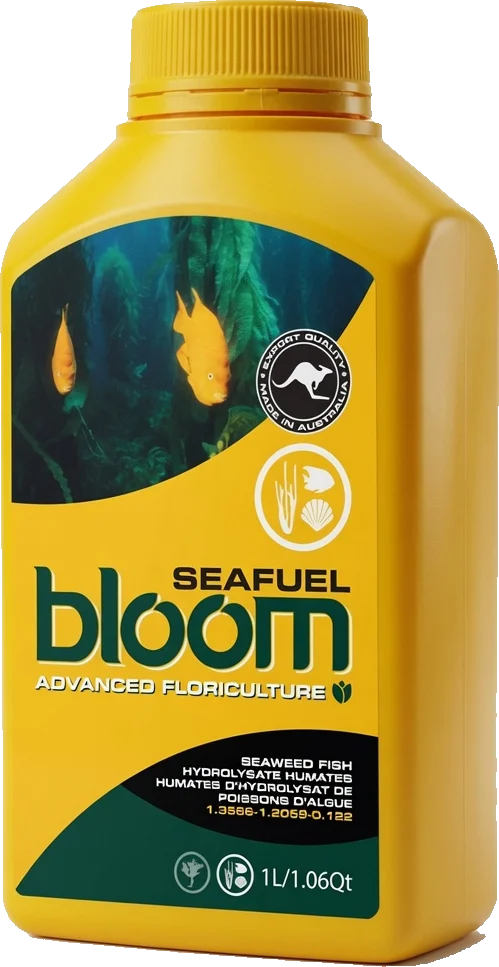
SeaFuel’s label declares two inputs: Durvillaea potatorum seaplant extract and hydrolyzed blue fin tuna (fish hydrolysate), plus a non-plant-food addition of 0.075% humic acid derived from Leonardite coal. We’re leaving SeaFuel’s N-P-K figures off, because they aren’t consistent across printings of the label artwork. Everything below only uses the numbers that hold up.
The trial, plainly
The grower ran SeaFuel per label directions on a section of her Phalaenopsis collection, watching for the two things orchid growers actually track: bud size and bloom quality. Her read on it, in her own words relayed to us: buds didn’t size up more than usual, but the flowers and buds that did form were noticeably strong. Not a bigger bloom. A tougher one.
That’s worth sitting with rather than rounding up. A grower who was only looking for a sales-friendly result could have reported “bigger blooms” and we’d have no way to check it. Instead the honest answer is split: one metric unchanged, one metric improved. We think that’s more useful to another orchid grower than a clean before/after would be, because it tells you what to actually expect instead of what to hope for.
Why this reads differently for orchids than for a flowering crop
On most of the crops we write about, “stronger flowers, same size” would be filed as a modest result. For orchid growers it isn’t modest — bloom substance is close to the whole game. A flower that holds its shape and doesn’t collapse early is the difference between a spike that sells and one that doesn’t, independent of how big any individual bud got.
We’re not going to turn one grower’s season into a universal claim, and neither is she. This is one commercial greenhouse, one collection, one grower’s own read on what she saw. It’s a data point, not a guarantee — which is exactly how she described it to us.
What this is useful for
If you’re growing Phalaenopsis or anything in that family and bloom substance matters more to you than raw size, SeaFuel’s input profile — seaplant extract plus fish hydrolysate, no synthetic growth regulator declared anywhere on the label — is at least worth a side-by-side on a few spikes before a full switch. Watch the same two things this grower watched: whether bud count or size moves, and separately, whether the blooms that do form hold up better once they’re open. Those are two different questions, and this particular trial only answered one of them clearly.
One more label detail worth knowing before you try it
SeaFuel’s safety data sheet lists the product at pH 4–5, with a specific gravity of 1.2–1.4 — meaningfully heavier and more acidic than plain water. For an orchid grower used to working with light foliar mists and dilute feeds, that’s a reminder to treat it as a concentrate that needs proper dilution per the label, not something to eyeball into a spray bottle at tap strength. The same sheet notes the product is fully biodegradable and incompatible with alkali agents — worth keeping in mind if you’re also running anything alkaline, like a potassium-hydroxide-based product, in the same feeding window.
It’s also worth being plain about what this single trial can’t tell you. One grower, one greenhouse, one season isn’t enough to separate “SeaFuel did this” from “this happened to be a good season for bloom quality anyway.” What makes it worth publishing isn’t statistical weight — it’s that the grower’s own report didn’t try to oversell the part that didn’t move. If a wider trial across more growers or more seasons changes that picture, we’ll say so here rather than letting one season’s honest result stand in for more than it can support. The same restraint applies to what humic acid and seaplant extract can honestly be said to do in another small-volume, specialty-niche setting: bonsai.