
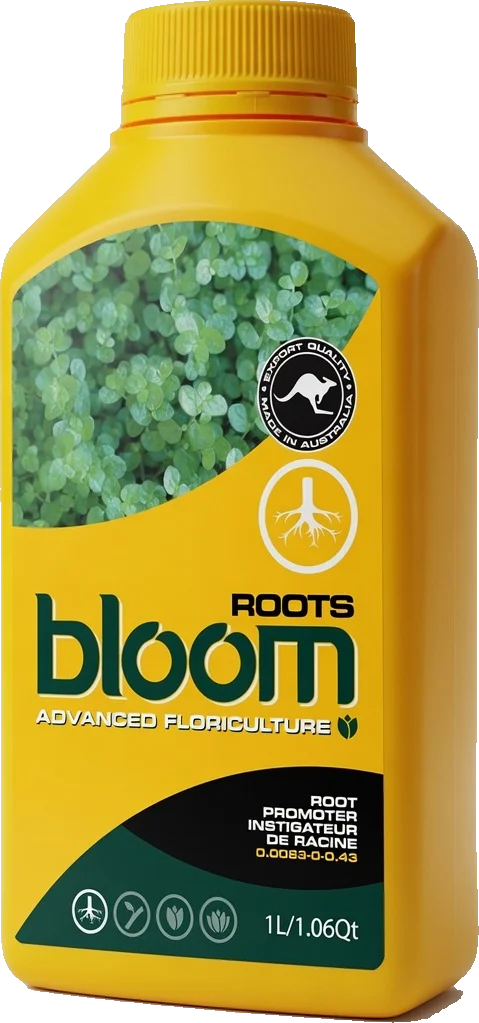
Root Architecture Before Bloom: What ROOTS Actually Brings to a Cutting Bench
Cut-flower growers don’t measure a propagation program the way a hydro grower measures a harvest. Nobody weighs a dahlia cutting’s yield. What matters on a cutting bench is whether the root ball is dense enough, fast enough, that the plant can be potted on or planted out on schedule — and whether that early root system holds up well enough to support vase life down the line. That’s a different success metric than tent growers use for the same category of input, and it’s worth looking at ROOTS through that lens specifically.
What’s actually declared on the label
Bloom ROOTS carries a simple, three-input composition: Durvillaea potatorum seaplant extract as the base, 0.075% humic acid derived from Leonardite, and 0.054% thiamine hydrochloride (vitamin B1). The guaranteed analysis is modest by design — 0.0083% total nitrogen, 0.43% soluble potash — because this isn’t a feeding product. It’s a propagation-stage input, used at 0.5 ml/L in solution or up to 1 ml/L as a cutting dip.
The honest version of the seaweed-extract science
Seaweed extracts as a category have real, published research behind them, and it’s worth growers knowing what that research actually says — and doesn’t say. Academic work on commercial seaweed extracts points to a signalling mechanism rather than a hormone dose: root-applied extract has been shown to activate cytokinin-responsive genes in test plants, and reviewers studying the category note that pulling extracts apart into fractions tends to fail — it’s consistently the whole, unfractionated extract that shows an effect in these studies, not an isolated “active ingredient.”
Here’s the part that matters for reading any seaweed-extract claim honestly: that body of research is built almost entirely on Ascophyllum nodosum and a handful of other kelp species studied side by side in controlled trials — and the results vary enormously by species and by extract. In one widely cited maize trial, a Laminaria extract produced a 15% gain in root length while the best-performing Ascophyllum extract in the same experiment produced 81% — a more than five-fold spread between two seaweed products in the same test. Durvillaea potatorum, the input actually declared on the ROOTS label, doesn’t appear in the largest published species comparison in this field at all. That’s not a reason to dismiss the category’s science. It’s a reason not to borrow another species’ numbers and apply them to this one.
What that means for a propagation bench
So what can be said honestly about ROOTS, specifically? The label tells you what’s in the bottle and at what concentration. The broader seaweed-extract literature is general research, not a test of ROOTS, and it shows that species and formulation both move the result substantially. Put those two facts together and the sensible approach for a cut-flower propagator is the same one that works for any input at this stage: dose at label rate, run it alongside your normal propagation routine rather than in place of it, and judge it on your own bench, on your own cultivars, over a few propagation cycles.
ROOTS isn’t positioned as a substitute for good propagation technique — clean cuts, the right media, consistent humidity. It’s a low-rate, early-stage input layered onto that technique. The label’s own numbers are small on purpose: this is a supplement to a propagation program, not the program itself.
Why propagation-stage inputs get judged differently
It’s worth saying plainly why a propagation-stage product like ROOTS reads differently from a feeding product: the window where it matters is short, and the stakes are specific. A cutting either strikes roots in a reasonable timeframe or it doesn’t, and a weak root system at transplant tends to show up later as a slower-establishing plant, not as a dramatic failure. That makes propagation inputs easy to under-rate and easy to over-credit — a strong batch of cuttings can make any additive look effective, and a batch grown from poor stock material will struggle no matter what’s in the dip bucket. The honest standard is the one used above: compare cuttings from the same stock, under the same conditions, with and without the input, across more than one batch before drawing a conclusion.
Reading it against your own crop
If you’re propagating cut flowers for vase life rather than growing for bulk or potency, track what actually matters to you — strike rate, time to transplant-ready root mass, and how the resulting plants perform once they’re in production. Those are the numbers that will tell you whether a 0.5 ml/L addition at the cutting stage is doing anything on your bench, with your cultivars, in your media. That’s a more useful test than any single percentage pulled from a lab trial on a different seaweed species. The same label-first standard applies to the fish-based inputs on the same bench, where the processing method behind the bottle matters as much as the species it started from. The same base-plus-booster logic, applied later in the cycle, is what’s behind what “finishing” means when the finish line isn’t harvest for cut flower growers. And if a popular rooting-aid claim is making the rounds on your own propagation forum, it’s worth reading what the small trials on rooting aids actually show before building a protocol around it.