
The Fish-Protein Nitrogen Number You Can’t Audit
Nitrogen-use efficiency gets talked about a lot at field scale — matching rate to crop demand, timing splits to uptake curves, cutting the nitrogen that just leaches or volatilizes before it ever reaches a root. Almost all of that conversation assumes the nitrogen content printed on the input is correct. For a bagged urea or a liquid UAN, that’s usually a safe assumption; those are commodity products with tight regulatory tolerances. For a fish-derived biostimulant, the research says it’s a much shakier assumption than most input budgets account for — and a budget built on the wrong number is a budget that’s wrong before the tractor leaves the shed.
The gap between a label claim and a lab measurement
A 2026 study in Frontiers in Nutrition set out to valorize fish-processing by-products through enzymatic and microbial hydrolysis, and measured nitrogen content across three production routes — microbial, microbial-plus-protease, and protease alone. The lab figures came in at 1.59%, 1.65%, and 1.53% nitrogen by weight. The comparison point: a commercial reference product on the market claims 3.00% nitrogen on its label. The lab-produced hydrolysates ran at roughly half the declared figure of the commercial benchmark they were measured against.
It gets more interesting from there. Despite the lower declared nitrogen, the lab hydrolysates outperformed the commercial reference agronomically. On 21-day-old wheat, the combined microbial-plus-protease route produced plants 54 cm tall with 2.3 g of biomass against an untreated control’s 44 cm and 0.7 g. The study states plainly that the “commercial reference showed no significant improvement over a water control.” A higher number on the label did not translate into a better-performing product in the field trial.
Why the number moves at all
The composition of a fish-derived input isn’t fixed the way a synthetic fertilizer’s is. A USDA National Organic Program technical evaluation of liquid fish products lays out the two dominant manufacturing routes and gives typical guaranteed analyses for each: fish emulsion, made by cooking fish by-products above 180°F, typically runs 5-2-2; fish hydrolysate, made with enzymes instead of heat, typically runs 2-5-3. Same broad input category, same nutrient family, and the N-P-K ratio inverts depending on which process made it. The same report states the obvious conclusion directly: “the composition of fish products may vary depending on the type…species of fish used, and the acid used.”
There’s a chemical reason the two routes diverge, and it matters beyond the N-P-K ratio. Research on protein hydrolysate biostimulants published in Frontiers in Plant Science explains that acid-and-heat processing partially or totally destroys several amino acids — tryptophan, cysteine, serine, threonine — and converts many of the survivors from the L-form to the D-form, a process called racemization, which the plant can’t use the same way. Enzymatic hydrolysis avoids both losses, retaining a higher ratio of intact peptides and L-form amino acids. Two products can declare similar nitrogen and still deliver a very different nitrogen that actually functions once it’s in the plant.
What a guaranteed analysis is actually for
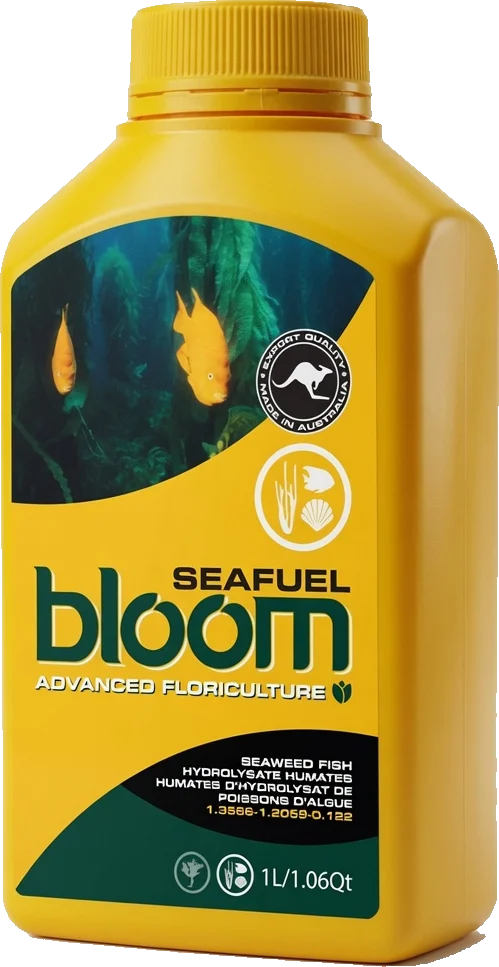
This is the whole case for buying from a line that declares a guaranteed analysis instead of a “typical analysis” marketing sheet. Bloom’s Seafuel label names the humic acid source (Leonardite) and the input (hydrolyzed Blue Fin Tuna, declared explicitly as a fish hydrolysate, not an emulsion). Its N-P-K figures aren’t consistent across printings of the label artwork, so we’re not quoting them here until they’re confirmed. A guaranteed analysis is a number a state agriculture department reviews against the product that’s actually in the bottle, the same regulatory structure that catches a 3.00%-claim product delivering 1.5% in a lab.
For an operation doing real input accounting — counting every nitrogen source into a seasonal budget the way any serious nutrient-use-efficiency program requires — the lesson from the research isn’t “avoid fish-derived inputs.” It’s “know whether the number on the bag is a guaranteed analysis or a typical analysis,” because those are two very different kinds of promise, and only one of them has been checked against what’s actually in the bottle.
There’s also a jurisdictional wrinkle worth knowing before sourcing any fish-derived input across borders: the USDA’s organic-use acid limit caps processing at a pH of 3.5 for a hydrolysate to qualify, while EU Regulation 354/2014 bans animal-derived protein hydrolysates, fish hydrolysates included, on the edible parts of organic crops outright — a rule that doesn’t apply in the US and shouldn’t be assumed to. Rules this specific, that vary this much by region and by process, are exactly why a declared, regulator-checked guaranteed analysis is worth more to a serious input budget than a sourcing claim alone — the same regulatory framework that catches an overstated nitrogen claim catches an overstated metals claim too.