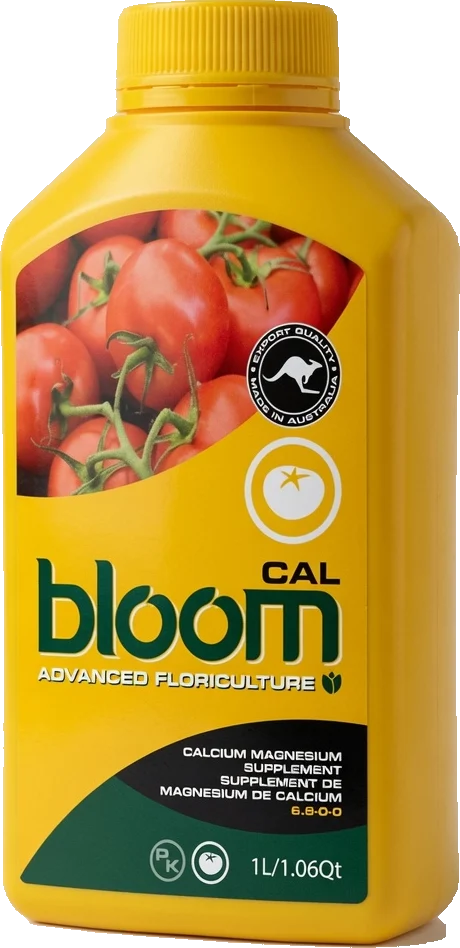
Most of what gets said about Bloom CAL focuses on the obvious headline numbers — the calcium, the magnesium, the iron DTPA chelate that holds up in high-pH water. The label carries a fifth declared nutrient that almost never comes up: zinc, at 0.0360%, chelated as zinc EDTA. In a passive semi-hydro or LECA reservoir, that’s not a footnote — it’s one of the few inputs standing between a healthy plant and a slow, hard-to-diagnose micronutrient deficiency.
Why a passive reservoir can’t fall back on soil chemistry
In a soil or soilless mix, zinc deficiency is rare because clay particles, organic matter and microbial activity all hold onto trace minerals and slowly release them, buffering a grower’s mistakes. LECA is chemically close to inert — it’s fired clay, and it isn’t releasing stored zinc into solution the way a living soil would. In a passive reservoir that only gets topped off between full changes, whatever zinc is in the nutrient solution the day it’s mixed is close to all the zinc a plant is going to get until the next refill. There’s no soil reserve quietly correcting an underdose.
That’s a real difference from a run-to-waste hydro system, where fresh solution is constantly replacing what the plant pulls out and any given day’s mix matters less. A sealed or rarely-flushed reservoir asks more of every declared nutrient on the label, including the ones measured in hundredths of a percent.
Why the chelate matters as much as the number
Zinc on its own doesn’t stay dissolved and available across a wide pH range — left unchelated, it can precipitate out of solution or bind to other ions and become unavailable to roots, especially as reservoir pH drifts upward over days between water changes. EDTA is a chelating agent: it wraps around the zinc ion and keeps it soluble and plant-available across a working pH range, rather than letting it fall out of solution as pH shifts. That’s the same chemistry already on Bloom CAL’s label for iron, just applied to a different metal — the iron is held by DTPA specifically because DTPA keeps working at a higher pH than EDTA does, up to roughly 7.5 versus EDTA’s effective range to around 6.5. Zinc EDTA is declared separately for a reason: it’s a smaller, different ion than iron, needing its own chelate rather than riding along on the iron’s.
What a zinc shortfall actually looks like
Zinc deficiency doesn’t announce itself the way a nitrogen or calcium problem does. It shows up as slower, less specific symptoms — smaller new leaves, shortened internodes, interveinal yellowing on newer growth — the kind of thing that’s easy to misdiagnose as a light, watering, or general-nutrition issue in a houseplant collection, especially one running several different genera in the same semi-hydro setup with no soil to mask the gap. By the time it’s visually obvious, it’s usually been building for a while, because the deficiency compounds slowly in a system with no reserve to draw from.
None of this means a passive reservoir needs a separate zinc supplement on top of a Cal-Mag product — it means the Cal-Mag product’s own label is worth reading past the headline N-Ca-Mg numbers. The declared analysis exists precisely because a sealed reservoir can’t correct for what isn’t in the bottle, and a nutrient measured at 0.0360% is not there by accident. It’s there because at that concentration, it’s still exactly what a plant needs and nothing it has to compete with, in a system with no other source to fall back on.
The practical takeaway for a semi-hydro or LECA grower isn’t to chase a bigger number — it’s to treat pH stability as a zinc-and-iron question, not just a calcium one. A reservoir held in the range where both chelates stay fully effective is doing more silent work than most growers give it credit for.
It’s also a reminder that a “full spectrum” micronutrient claim on a competing product means little without a chelate name attached to each metal. A label that lists zinc, iron, manganese and copper together but doesn’t say how any of them are held in solution is asking a grower to trust that all of them survive the same pH swings — which, chemically, they don’t. Reading a Cal-Mag label past the big three macronutrients is a cheap way to find out whether the rest of the bottle was actually engineered for a sealed reservoir, or just formulated to a target analysis and left at that.