
The Sodium Math Nobody Mentions When They Tell You to Steep Your Own Seaweed
If you garden long enough, someone will tell you that steeping a bucket of kelp in water is basically free fertilizer — just weigh it, soak it, and use the liquid. It’s a reasonable-sounding idea, and it isn’t wrong that seaweed contains useful stuff. What it skips over is the one ingredient that comes along for the ride no matter how you steep it: sodium. And the arithmetic on that is worth doing before you fill the bucket.
What’s actually in dry seaweed
Published composition data for brown seaweed puts sodium at roughly 3–4% of dry weight for Ascophyllum nodosum, the most commonly available kelp species sold dried for home use, and 0.9–2.2% for Laminaria digitata. That means every gram of dry Ascophyllum you dissolve into a liter of water adds roughly 30–40 mg/L of sodium to that liter — before accounting for any seawater still clinging to fresh or beach-cast material, which adds more on top and isn’t something we have a reliable figure for.
Where that number runs into a real limit
University extension guidance for ornamental and greenhouse crops puts the acceptable sodium ceiling at roughly 50 ppm in irrigation water, with high sodium flagged as a cause of reduced calcium and magnesium uptake and, over time, excess leaching of both from growing media. Run the numbers and that ceiling arrives fast: dissolving just 1.2 to 1.7 grams of dry Ascophyllum per liter — well under a tablespoon — already spends the entire 50 ppm sodium budget for that liter of water, with nothing left over for whatever else you were hoping the steep would deliver.
Why we’re not going to tell you our own sodium number
Here’s where we have to be straight with you: we can walk through this arithmetic for a home steep because you can weigh the dry seaweed yourself before it goes in the bucket. We can’t do the same exercise for Bloom Seaweed, and neither can any competitor, because no fertilizer guaranteed analysis — ours included — carries a declared sodium figure. That’s not a loophole; sodium and chloride simply aren’t nutrients a guaranteed analysis is required to report. So we’re not going to imply our bottle is “the low-sodium version” of a home steep, because that’s a number nobody on either side of this comparison actually has on a label.
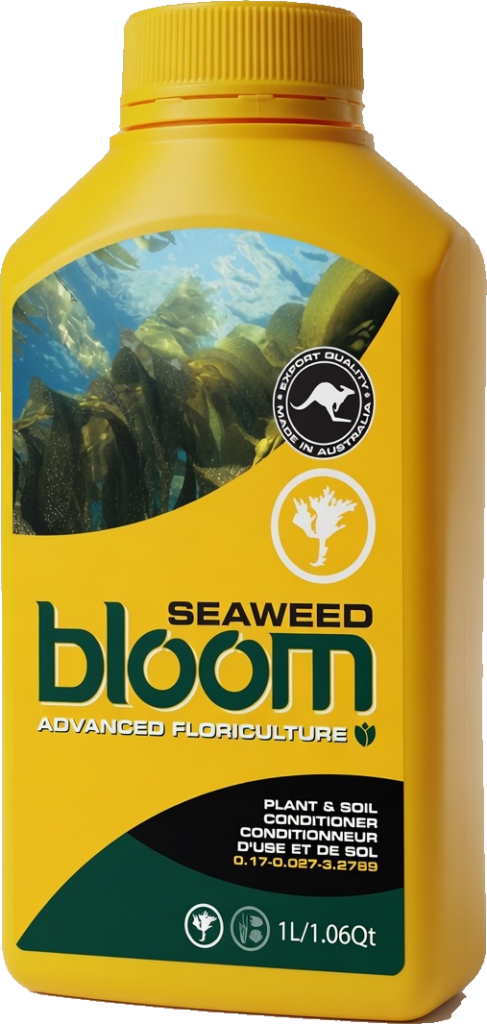
What is on Bloom Seaweed’s label is a declared composition — Durvillaea potatorum seaplant extract, 0.17-0.027-3.278 — dosed as a finished liquid concentrate at 1 ml/L. That’s a difference in dose form, not a claim about sodium content: a measured milliliter of finished concentrate and an eyeballed handful of dry kelp in a bucket are simply not the same kind of input, and only one of them lets you reason about what else is coming along with it.
If you’re going to steep your own seaweed anyway, the honest advice is to weigh it, not eyeball it, and to treat the sodium arithmetic above as a real cost of that method — not a hypothetical one.
Why this doesn’t apply the same way to every plant
Sodium sensitivity isn’t uniform across a backyard garden, which is part of why this threshold matters more for some beds than others. Ornamentals and container plantings — where the extension figures above actually come from — tend to sit on the more sensitive end, since they’re often grown in limited soil volume with less buffering and less drainage than an open garden bed. A tomato patch with good native soil and normal rainfall to flush it isn’t in the same position as a row of potted annuals getting hand-watered all summer. That’s not a reason to ignore the arithmetic — it’s a reason to weigh it more heavily for container and bedding plants specifically, and to treat a backyard vegetable row with a bit more room for error.
The takeaway for a backyard garden
None of this means dry seaweed is useless, or that a home steep can’t be part of a garden routine. It means the “it’s basically free” framing leaves out a real input — sodium — that scales with exactly how much dry material you put in the bucket, and that a published extension threshold exists to measure it against. Weigh what you’re steeping, keep it well under the gram-per-liter range above if sodium matters for what you’re growing, and know that reaching for a measured liquid concentrate and reaching for a bucket of kelp are two different tools, not two versions of the same one. If you’re using Bloom Seaweed itself rather than a raw steep, its own garden rate table already does this dose-matching for you.