
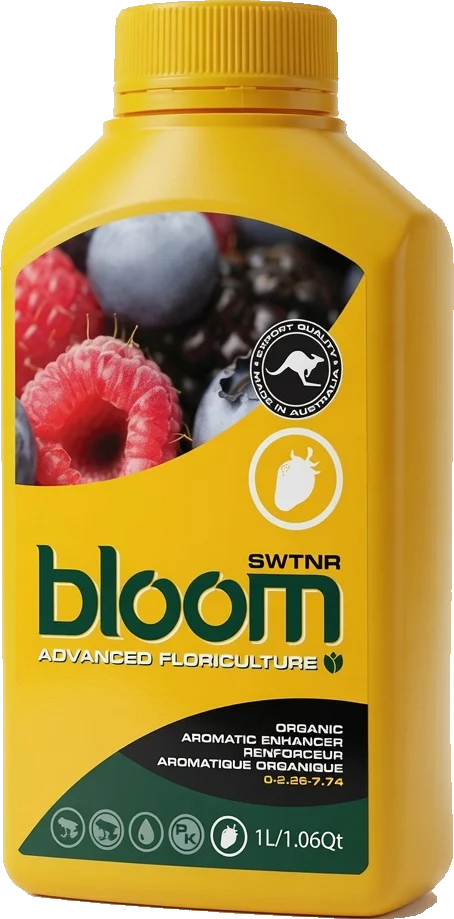
When Two Versions of Our Own Label Disagree, We Print Neither Number
Semi-Hydro & LECA Houseplant · Brand & Experience
In a passive LECA reservoir, there’s no weekly flush diluting a mistake away. Whatever concentration goes into that water column sits there, feeding the roots sitting in it, until the next full change — which for a lot of semi-hydro growers is weeks out, not days. That’s exactly the setup where getting a guaranteed analysis number right matters most, and it’s why we want to be upfront about one of our own products where, right now, we don’t have one number to give you.
Bloom SWTNR is sea water and Porphyra abyssicola extract, with a trace of thiamine hydrochloride. Those three things are settled — they’re on the label artwork from 2013 and they’re on Nate’s own retained sample bottle, and both agree with each other. What isn’t settled is the guaranteed analysis number itself. That same 2013 label prints one set of N-P-K figures. The current bottle render and the live product page print a different set entirely — not a rounding difference, a different analysis. And the current bottle’s derived-from line adds malted barley extract, an ingredient the 2013 label artwork doesn’t mention at all.
Our standing rule when two of our own sources disagree on a figure: leave the number off the deliverable until it’s resolved. We’re following that rule here, in public, instead of picking whichever number reads better.
Normally there’s a hierarchy. Here, it breaks down.
We’ve printed the “label beats feed chart beats website” rule on this blog before, and it’s a good rule — most of the time one source is simply more current or more carefully checked than the others. It doesn’t resolve a case where two artwork versions of the label itself print different analyses and we can’t yet confirm which one describes what’s actually in current US-market bottles. That’s a question for Geoff, not something we’re going to guess our way past.
What’s actually settled vs. what isn’t
For a semi-hydro grower dosing a reservoir that might sit untouched for two or three weeks, that distinction isn’t academic. If the two candidate guaranteed-analysis figures were close together, we’d be comfortable using the more conservative one as a working estimate and flagging the gap. They’re not close — one reads as a much higher-potency analysis than the other — which is exactly the situation where printing either number as settled fact would be worse than printing neither. A dosing mistake that would wash out of a flushed soil pot in a week doesn’t wash out of a reservoir that isn’t getting flushed at all.
The honest version of a Bloom SWTNR product page, until this is resolved, names what’s reliably known — the seawater-and-red-algae-extract input, the thiamine trace, the fact that it’s one of six products sharing recurring ingredients across our line — and is quiet about the exact N-P-K ratio. We’d rather a semi-hydro grower see that gap acknowledged than find a confident-sounding number on a bottle that turns out, a season later, to have been the wrong one for their reservoir.
If a label disagrees with itself, the right move isn’t picking the number you like better — it’s saying so until it’s fixed.
If you’re already running SWTNR in a passive LECA setup, this doesn’t change what to do day to day — keep using whatever rate you’ve been using, since nothing about the product itself has changed. What it means is that if you’re looking at SWTNR’s marketing material for a precise N-P-K number to plan a new reservoir around, you won’t find one from us right now, and that’s deliberate rather than an oversight. The same caution applies to anything else in a semi-hydro setup: a derived-from line and a trace-ingredient percentage are the kind of small print that’s easy to skip past, but they’re also usually the most reliably sourced part of a label, because they don’t move around between artwork revisions the way a guaranteed analysis sometimes does when a product gets reformulated.
We’ll update this post the day Geoff confirms which analysis is current for US stock. Until then, this is the honest state of what we know.