There’s a persistent piece of garden-forum advice that says you can pull humic acid out of leonardite, compost or even garden soil yourself with nothing more than kitchen vinegar — soak it, strain it, and you’ve made your own humic concentrate for a fraction of what a bottle costs. The chemistry behind humic acid extraction says that’s close to backwards. Vinegar doesn’t dissolve humic acid out of ore. It’s the thing used to precipitate humic acid out of solution — and it mostly can’t even do that at kitchen strength.
Why acid is the wrong tool for extraction
Humic acid is not soluble in water under acidic conditions, but it is soluble at higher pH values. That’s the opposite of what the vinegar method assumes. Commercially, humic acid is pulled out of raw ore with an alkali — potassium hydroxide, sodium hydroxide, or sometimes water itself, all of which raise pH and deprotonate the humic molecules so they let go of the insoluble calcium, iron and aluminum humates they’re locked to in the ore. Acid does the reverse job: the published extraction standard for isolating humic acid calls for a pH of 1.0, plus or minus 0.1, to reliably precipitate it back out of an alkaline solution and recover it as a solid.
Household vinegar, splashed onto a slurry of leonardite ore, doesn’t get anywhere close to pH 1. The ore itself buffers against the acid — mineral content in the raw material resists the pH drop — and a realistic result lands somewhere around pH 3 to 4. That’s nowhere near the 1.0 the extraction standard calls for, which means the vinegar method mostly fails to do either job: it isn’t alkaline, so it isn’t extracting humic acid from the ore the way a commercial processor would, and it isn’t acidic enough to reliably precipitate humic acid that’s already dissolved, either.
Why this matters more than it sounds like it should
It’s an easy mistake to make, because the underlying logic sounds reasonable: acid dissolves things, so acid should dissolve humic acid out of ore. The actual relationship is the inverse — the molecule is held insoluble by the acidic, protonated form it naturally sits in within the ore, bound to calcium, iron and aluminum. Getting it into solution means raising pH, not lowering it. A home gardener pouring vinegar over a pile of leonardite or compost and expecting a usable humic concentrate is running a process in the wrong direction, at a strength too weak to complete either end of it.
What’s actually on Bloom’s label
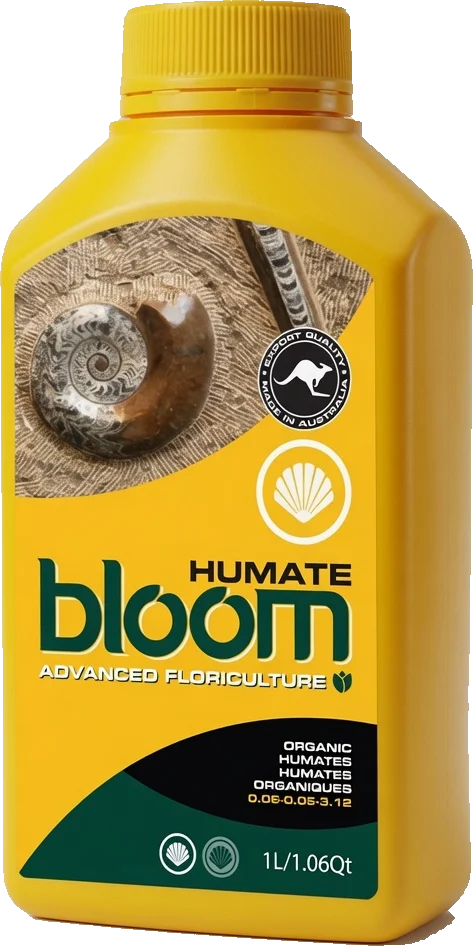
Bloom Humate declares its potash as derived from potassium hydroxide — the alkali route, consistent with how humic acid extraction actually works — alongside 10% humic acid derived from Leonardite, at a dose of 2.5 ml/L. The label naming potassium hydroxide as the source of the declared 3.12% potash doesn’t by itself prove KOH was the extraction reagent rather than a neutralizer added afterward, so that distinction is worth holding loosely. What the label does establish plainly is the potassium left behind in the bottle, which matters to a hydroponic grower managing their overall potassium budget — and it’s a detail a vinegar-and-leonardite experiment has no equivalent of at all, since nothing about that process is declared, dosed, or repeatable from batch to batch.
None of this is an argument against curiosity on the potting bench — plenty of garden chemistry is worth testing at home. It’s a narrower point about this specific method: the pH math doesn’t support what the vinegar-extraction claim promises, on either side of the reaction it’s supposed to run. If the goal is a working concentration of humic acid, the chemistry says to reach for an alkali, not a splash of vinegar from the pantry.
It’s the same reason we went back to Humate’s own label artwork rather than an internal cheat sheet when two of our own documents disagreed on its declared humic-acid percentage — the filed, regulated document settles a question a summary can’t. It’s worth saying plainly why this myth persists: vinegar is cheap, already in the kitchen, and “natural,” so it feels like the obvious choice for a natural-sounding product. But humic acid’s chemistry doesn’t care what feels intuitive — it cares what the pH actually is, start to finish. A fall routine built around an alkali-extracted, labeled product skips the guesswork entirely, which is a fair trade for the few dollars a bottle costs against an afternoon spent straining vinegar through a bucket of ore for a result that was never going to form.